
Designed & Made in Taiwan
MAKE COMPOSITE EASY
Carbon-CNC makes cutting composite sheet
fast and simple.
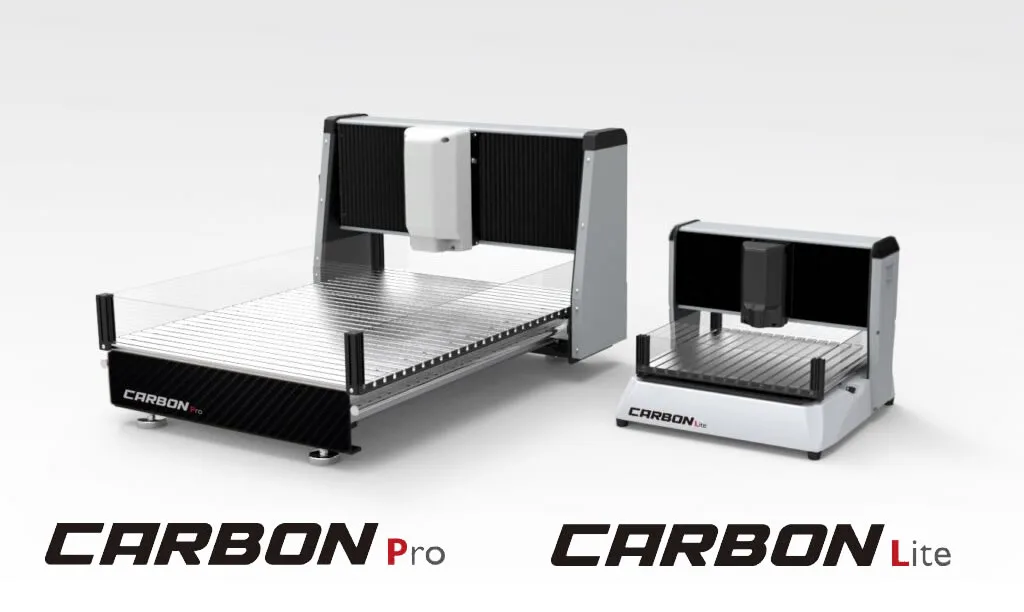
Compact footprint
A desktop design that fits easily into labs and R&D centers.
Protected and quiet
Carbon fiber dust protection
High-speed BLDC brushless spindle
Made in Taiwan, fully supported
Deep composite cutting experience
Entire machine made in Taiwan / fast service
Auto tool setting, easy software
Automatic tool setter for fast surface zeroing
In-house control software that is easy to learn
A desktop CNC built for composites
Professional results,
right on your workbench.
Our team built years of composite experience into the design of Carbon-CNC. With an intuitive interface and simple operation, it is a professional machine you can put to work right away.
01
Not limited to one material
Carbon-CNC mills and profiles a wide range of materials, for prototypes, test coupons and even low-volume production. Our team is available for machining support and advice whenever you need it.
02
Built for composite machining
Machining composites and specialty materials depends on dust collection and workholding. Carbon-CNC is designed around both.
03
From prototype to low-volume production
Test coupons, model development, fixtures and small production runs: Carbon-CNC handles them all.
04
Designed and made in Taiwan, fully supported
Carbon-CNC is designed and manufactured in Taiwan, so technical support and repairs come straight from the people who build the machine.
CARBON-CNC MAKES COMPOSITE EASY!
Carbon-CNC is built for speed.
Cut test coupons and ship prototypes right away, and make models and fixtures on the same machine.
Why Carbon-CNC
Is cutting CFRP coupons a pain point? Borrowing time on a production machine or waiting on an outside shop is slow, and small jobs often get turned down. Bring your drawing (DXF, EPS, PDF, even JPG), set it up in a few steps, and cut your coupons or prototypes right away. Carbon-CNC puts the schedule back in your hands.
What sets it apart
Carbon-CNC is built for dry machining of specialty materials: fiberglass sheet, CFRP (thermoplastic and thermoset), thin non-ferrous sheet, ABS, PMMA, PC and more.
Cutting CFRP Sheet and Blind Holes with Carbon-CNC
Counterboring and Milling CFRP Sheet with Carbon-CNC
MADE IN TAIWAN
Designed and built in Taiwan
DRONE PARTS MACHINING
Carbon fiber drone parts, from frame to antenna mount, on one machine
Loading 3D model…
Click a part for details · Drag to rotate · Scroll to zoom
Details ↓
Illustrative model based on typical 5-inch dimensions
Parts you can cut
Standard parts
Frame plates and arms
5-inch FPV arms are usually 5 mm, 7–10-inch arms 6 mm, and bottom plates 2.5–3 mm. All four arms can be cut from one sheet in a single setup, and ±0.05 mm accuracy keeps the four motor mounts consistent.
Tube clamps and connectors
For common 16/20/25/30 mm carbon tube diameters, clamp bores have an 8–15 mm radius that a φ4 end mill can form. The ER11 collet takes both 4 mm and 6 mm shanks.
Antenna mounts and insulators
Carbon fiber conducts along the fibers, so GPS and video antenna mounts must be FR4 or G-10. The same machine cuts both materials, so there is no need for a second supplier.
Battery plates and small parts
ESC spacers, camera mounts, landing gear pads and other small parts can be nested on one sheet. A vacuum table and tabs keep parts from flying loose on the final cut.
ASTM test coupons
The largest single coupon envelope across D3039, D6641, D5379, D2344 and D5961 is 250×36 mm, which fits both models, so material qualification and flight parts share one workflow.
Large multirotor structures
Agricultural spray drone center plates can reach 328 mm in diameter. The 510×760 mm travel of the Carbon Pro takes standard 400×500 and 500×600 mm carbon sheets directly, with no pre-cutting.
PRODUCT LINE
Find the right Carbon-CNC model
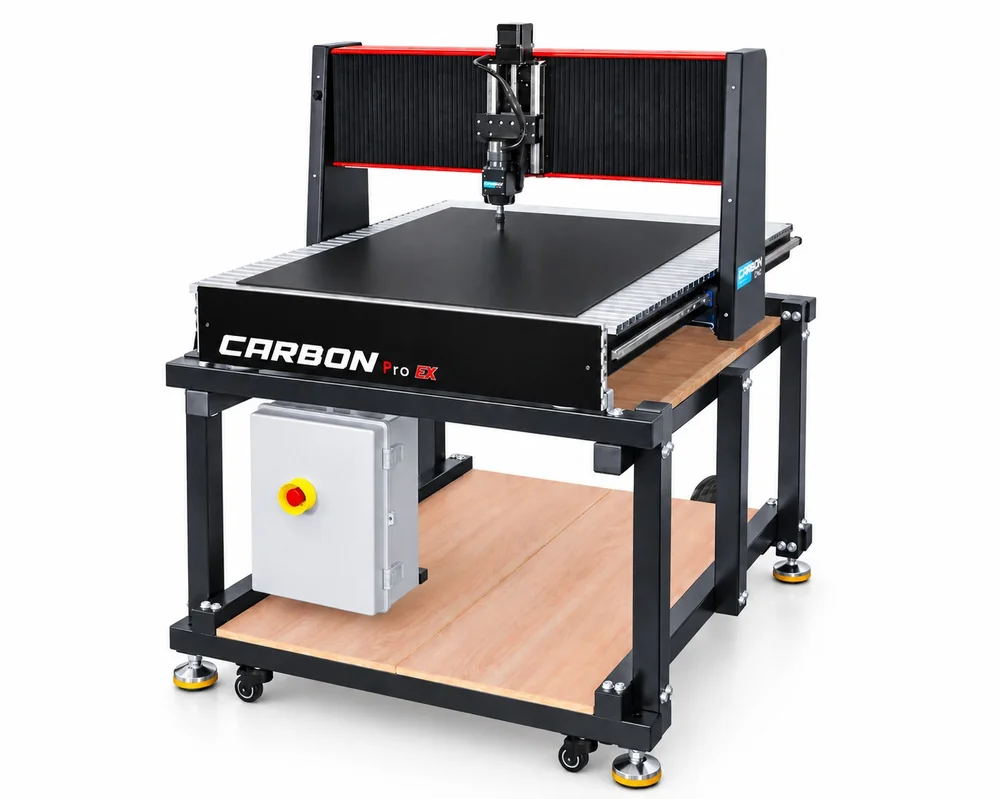
CARBON PRO EX · ADVANCED
Large drone parts and full-sheet coupon cutting
Working area 710*900*150 mm | Accuracy ±0.05 mm | 350W brushless spindle
View specs →
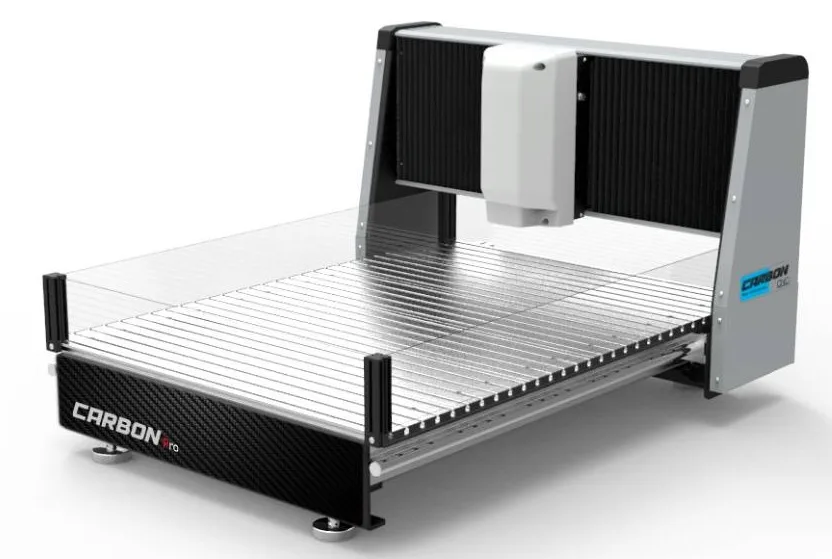
CARBON PRO · PROFESSIONAL
For labs and R&D centers with limited space
Working area 510*760*100 mm | Accuracy ±0.05 mm | 350W BLDC spindle
View specs →

CARBON LITE · ENTRY-LEVEL
For labs and R&D centers with limited space
Working area 360*300*80 mm | Accuracy ±0.05 mm | 200W BLDC spindle
View specs →
TECHNICAL ARTICLES
Drone parts machining articles
01Materials & Feasibility
How Should You Cut a Carbon Fiber Drone Frame? 5 CFRP Sheet Cutting Methods Compared
Which method should you use to cut carbon fiber drone parts? Waterjet, laser, CNC milling, saw and hand cutting compared on kerf width, edge quality, heat effect, lead time and minimum batch, plus why lasers are unsuitable for carbon fiber structural parts.
10 min readRead article →
04Parameters & Tooling
How to Set Speeds and Feeds for Drone Parts: A 20,000 rpm Spindle Parameter Chart
When machining carbon fiber drone parts, you will never use up the feed rate limit; the spindle speed limit is the real bottleneck. Using Harvey Tool and Onsrud cutting data, we convert workable parameters and thermal thresholds for 2–6 mm end mills within 20,000 rpm and 2,500 mm/min.
14 min readRead article →
14Buying Decisions
Cut In-House or Outsource? Cost and Lead-Time Math for Carbon Fiber Drone Parts
Should you cut drone parts yourself or outsource them? Using published job-shop prices, lead times, and engineer survey data, we work out the break-even point between an in-house desktop CNC and outsourced carbon fiber cutting. The dividing line is not unit price; it is how many revisions you make each month.
10 min readRead article →